| Bray
Yacht Design and Research Ltd. White Rock, B.C. |
|
|
A decision was made to look into various retrofit options and the choice was narrowed down to a bulbous bow and some form of roll dampening fins. There has been considerable interest in the advantages of bulbous bows and a large data base has been established on the West Coast from work done on fish boats and long range motoryachts. The roll dampening fins were an extra, considered while the boat was out of the water. In fact, a hydraulically activated system was evaluated but ruled out because of cost considerations.
The situation was complicated by the fact that Amnesia has a deep V hull form, twin 1100 h.p. diesels and was designed to cruise at 18 knots and top out at 22. In her present condition top speed was limited to 18 knots and a quick check of the fuel flow meter precluded any kind of extended cruising much over 14 knots. This is still reasonably fast in anything but flat water, but there are 'bragging rights' to consider. It is 'how fast will she go?' that counts! Not to mention how much (or little) fuel it takes to achieve that speed. Bulbous bows are not normally associated with deep V, hard
chine, wide spray-flat, two lift strakes per side kind of boats. Not that the two are
incompatible, however that hull type generally travels at speeds outside the range where a
bulb is effective. Now it is safe to say that work is being done on 'faster' bulbs, but
before all you 'express cruiser' guys step up let me add that speed is relative to the size
of the boat, and in this case was effective because Amnesia is a 75 footer.
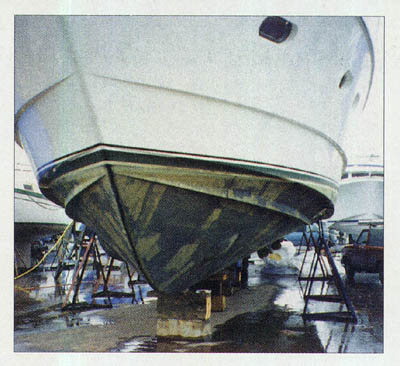
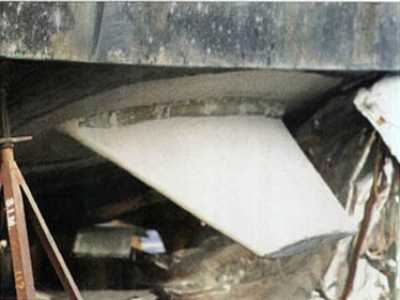
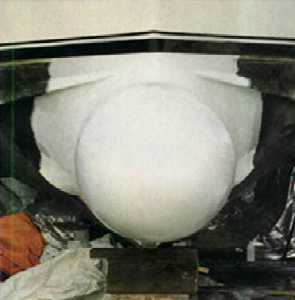
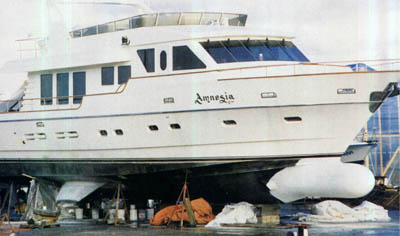
'Amnesia' generated considerable interest over the course of a month while she was being worked on. The general reaction was "Holy Cow, what is that?" and "Is that some kind of hydrofoil system?". As you see in the photos, the bulbous bow is 3'-6" in diameter protruding 5'-2" forward from the stem at the waterline. It looks rather large on first view, however it is carefully proportioned for maximum effectiveness. The twin keels are 9 ft. long at the root tapering to 5 ft. at the tip, 3 ft. deep, airfoil shaped, angle 30 degrees from the vertical, and place as far outboard as possible. This shape and position also adds lift to the stern. They should have been larger for optimum performance, but the size was limited by the depth of the vessel and the overall beam. They do not project outside the hull and also match the center skeg in draft. Despite having considerable years of experience in 'that sort of thing' there was still a healthy amount of skepticism around the old boat yard before the launch. Launch day came and we were invited to attend the sea trials with the owner's representative on board, for an assessment of our new- fangled appendages. The boat looked good at her berth sitting level with the boot top showing. It was a typical Vancouver day; that is, it was raining and blowing, with occasional burst of sunshine just to remind us how the rest of the world must live. We headed down the muddy Fraser River, where runs were conducted at various speed with sundry professionals venturing out onto the fore deck to hang over the bow for short periods of time. We must have looked like a sea-sick crew on the choppy waters! All looked good over the bow. The owner's rep. was the only one aboard who had been on the boat previous to the retrofit and the only one who could judge the difference in performance. First 10 knots, then 12 knots, 14 knots, 16 knots, all looked really good, so we opened the throttles all the way up. Over 16 knots the bow came way up as the top of the bulb broke free from the water's surface. Still the bow wave was held below the height of the spray knocker at all speeds and the bulb was dubbed a success. With the tidal current running in the river it was impossible to ascertain any real speed advantage but the general consensus was that the vessel seemed to move more easily. A broadside attack from a passing tug's wake and some S-turns were the only tests for the keels, which also appeared to be doing their job effectively. Soaking wet from our adventures on the fore deck and cold from the wind we headed back after 2 hours of trials, happy with the results.
The next day the owner's rep. delivered Amnesia to her permanent berth in Vancouver but not before trying her out once more. Now in the broad expanse of English Bay, without river current running, he opened the throttles up but this time also adjusted the trim tabs. Why hadn't we thought of that the day before?! The knot meter rushed up to 16, then 18, and then 20 knots and continued to move up at a slower pace settling on 21.5 knots. With the trim flatter the bulb remained submerged, rushing ahead of the boat like a dolphin racing a bow wave. The twin keels lifted the stern, dampening any rolling motions. The owner is happy with the improvements, the owner's representative is pleased, and in fact almost skeptical that the vessel would gain more than it's 1.5 knot calculated speed increase. People along the waterfront are talking and asking questions about the new, the improved Amnesia. No one seems to remember the old Symbol 75; you know the one I mean, what was her name? Patrick J. Bray, |
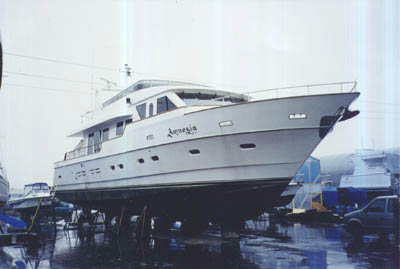 The motor vessel Amnesia was the
first of the Symbol Motoryacht Co.'s new 75 foot pilothouse series. A beautiful boat both
inside and out, she was handcrafted to high standards of finish and launched just over 1
year ago, unfortunately to a less than perfect start. Considerably over her designed weight,
she floated a good 4" below her lines and was even deeper once the owners had moved
everything aboard. Consequently she never achieved her design speed and suffered from an
excessively high bow wave. The owners cruised her up and down the West Coast for a season
while contemplating their next move and that is where our story begins.
The motor vessel Amnesia was the
first of the Symbol Motoryacht Co.'s new 75 foot pilothouse series. A beautiful boat both
inside and out, she was handcrafted to high standards of finish and launched just over 1
year ago, unfortunately to a less than perfect start. Considerably over her designed weight,
she floated a good 4" below her lines and was even deeper once the owners had moved
everything aboard. Consequently she never achieved her design speed and suffered from an
excessively high bow wave. The owners cruised her up and down the West Coast for a season
while contemplating their next move and that is where our story begins.