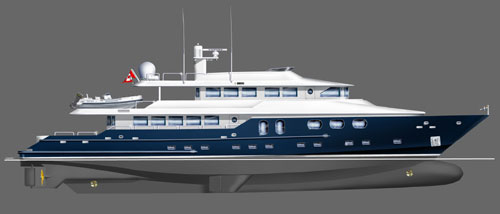
| Designed
as a world cruising and personal exploration vessel, the Explorer
class is for adventurers who want to circle the globe. It's heritage
is from the offshore supply vessels and the working fishing fleets
of the Pacific Northwest. A robust ship of proven seakeeping ability
she is fitted with a bulbous bow and Kort nozzle for efficiency
as well as roll reducing twin keels. She will be the primary residence
for an experienced owner with ocean cruising under his belt. The
extensive range, on-board watermakers, and great storage capacity
make trans - ocean crossings a matter of course.
The large machinery
space is fitted with twin slow-turning diesel engines and twin
generators with dry stack exhausts. A hydraulic cruising generator
as well as a hydraulic 'come home' powering system are specified.
Aft of the engine room is a large workshop and storage room. The
accommodation level has four staterooms with an on-deck master
suite. The main deck lounge opens out onto the main deck where
the personal sub, seaplane or helicopter, jetskis, windsurfers,
kayaks, and dinghies are to be kept. With the equipment off-loaded
this area becomes a 26' x 40' sunning and activity area. Tennis
anyone? The professional galley and dining room are forward and
occupy the full width of the ship. The bridge has direct access
to the anchor windlass forward, the side decks, the aft wing stations,
and the upper aft deck. The helm area is large and complete with
chart table, electronic charting, flag lockers, and radio communication
area. There is plenty of room for guest seating in the observation
areas as well as a captain's or owner's cabin aft. The upper aft
deck overlooks the main deck, for spectators and sun worshippers
who do not want to be disturbed. Up the outside staircase to the
large flybridge you will find a barbecue, dinette, and settee
under the permanent sun top. Many bridge controls are duplicated
here for running the ship from 'up top'.
The steel hull and
aluminium superstructure have over 4" of insulation as well
as double paned windows for maximum comfort in all climates. There
are four watertight bulkheads and the vessel meets the ABS Rules
for Motor Pleasure Yachts of unrestricted service. All equipment
on board from anchors and rode to the fire fighting and emergency
bilge pumping system are 'big ship' design. The piping and wiring
are also of commercial standard. 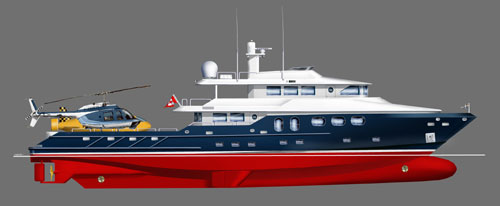
The Explorer is a rough,
tough, no nonsense, go anywhere class of vessel with the comfort
and equipment to do it in style. The raised bow and protected
side decks challenge the sea and the high bulwarks protect the
sailors on board. The covered decks shield from rain and sun to
meet the demands of a wide range of climate. Once at a remote
anchorage, equipment can be lowered off the main deck to explore
the depths, play in the wind and waves, or fly off for a picnic
on an untouched beach.
Hull Engineering, Design and Construction
The Explorer series hulls are designed using the latest technology
in offshore vessels. We use the B.C. Research model test tank
(at the University of British Columbia) to develop our advanced
hulls for optimum efficiency.
Hull and deck are designed
and built to American Bureau of Shipping Rules for Unrestricted
Offshore Motoryachts and the recommendations of the American Boat
and Yachting Council. The full displacement hull features pitch
and roll-dampening fixed twin keels which reduce resistance, increasing
cruising speed without increasing fuel consumption. They also
allow the use of unimproved yards dependent on tides, or even
a tidal beach for haul-outs.
The hull, with widely
flaired bow sections, has great reserve buoyancy for lifting to
head seas. Positive stability is achieved well beyond 150 degrees
making the ship self-righting in extreme conditions. It is engineered
for integrity in all weather conditions to ensure survivability
in breaking seas, and employs a spray knocker to reduce spray
on deck.
We use the new Bray
Tunnel Enclosures around a large diameter highly skewed propeller,
developed from technology used on the whisper quiet stealth submarines.
Using a very slow rpm we can greatly increase propeller efficiency
while reducing noise. This also enables the ship to drive into
head winds and big seas without a change of speed. Cruising speeds
of 14 knots without the penalty of excessive fuel consumption
are possible using these systems.
Engine Room and Mechanical
Systems
The engine room has full headroom with easy access without compromising
accommodations. It is "clean" and free from a complexity
of valves, wiring, and switches, carefully utilizing enclosed,
planned panels for ease of access. Automatic and manual fire fighting
systems are standard.
We use heavy duty diesels
with large reduction gear to turn our propellers. A flexible shaft
coupling is used in conjunction with soft engine mounts that are
essential to reduce engine room noise and transmission into the
accommodations. The ship achieves near silence while underway
in all accommodation areas. Dry-stack exhaust is standard to reduce
exhaust back pressure and noise, increase engine efficiency and
life, and for the removal of exhaust gas emissions from the boat
deck. Engine cooling systems are simplified using keel coolers
which extend engine life by eliminating salt water.
Fuel and holding tanks
are integral to the hull with sight gauges on the fuel tanks.
Water tanks are stainless steel. All tanks have access for clean-out.
The ship uses Sea-chests with all salt water entering from a single
thru-hull into two accessible columns, eliminating multiple hull
openings. Heavy plexiglass is mounted on the top for viewing into
the chests and the tops can be removed while the vessel is afloat
for maintenance and cleaning out.
An engine replacement
system is designed employing hatches in the deck. This unique
and valuable concept will be greatly appreciated when major mechanical
change-overs are necessary.
|